
Impacts of FGM/C
A girl who has undergone female genital mutilation/cutting (FGM/C) can often face consequences that are dangerous and distressing. Many girls and women will experience lifelong negative impacts. The harmful effects can be physical, psychological and economic, often leading to difficulties throughout her childhood, adolescence and adult life. There are also negative impacts for wider households, communities and countries’ economies.





Physical and psychological harm
 Childhood
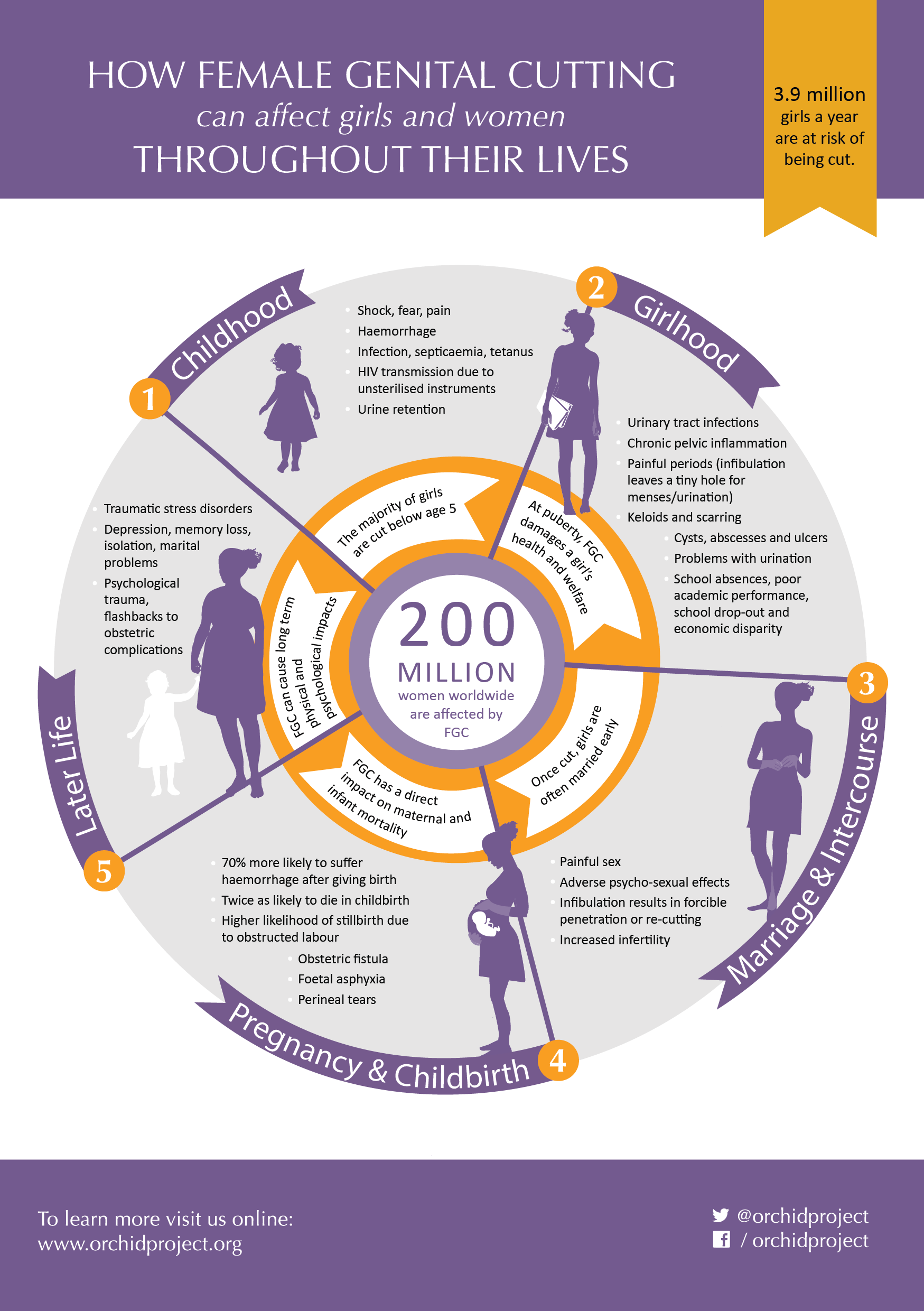
In some cases, girls die as a direct result of being cut. These deaths can be caused by a range of complications, including haemorrhage, contracting septicaemia, tetanus, or HIV, due to unsterilised tools.
A girl may also experience shock, fear, pain and trauma.
Girlhood
After undergoing FGC, a girl can experience difficulty in passing urine and difficulties with menstruation, because her urethra and/or vaginal opening may have been blocked through FGC Types II and III. This can lead to infections and chronic pelvic inflammation. Girls may also suffer from cysts, abscesses and ulcers after being cut.
Girls who are cut may also suffer educationally. Health problems resulting from FGC can cause them to miss school, leading to higher dropout rates and economic disadvantages later in their lives. FGC is also often a precursor to child marriage.
Marriage and intercourse
 With all types of FGC, sex can be painful and traumatic. Women and girls who have undergone FGC Type III will often have to be re-cut to have sex or may experience forced penetration. It is not only the first time that is painful. For many women, scar tissue will continue to cause pain during sex throughout their lifetimes, whilst their partners may also experience pain and trauma during sex.
After a girl is cut, there can be an increased risk of infertility, which within some communities may cause her to be abandoned by her husband.
Pregnancy and childbirth
FGC has a direct impact on maternal and infant mortality. Women who have undergone FGC Type III are 70% more likely to suffer haemorrhage through giving birth, are twice as likely to die in childbirth and have a higher likelihood of stillbirth due to obstructed labour. Women who have undergone FGC Type III are also more likely to experience other complications including obstetric fistula, foetal asphyxia, and perineal tears*.
FGC and child marriage
There is a strong link between FGC and child marriage. Among some communities, a girl is cut to ensure her marriageability, or in preparation for her marriage. Often, once a girl is cut she is considered ready to be married. This, in turn, can lead to increased instances of early pregnancy before the girl is physically mature, which can lead her to experiencing further physical and psychological problems. Both FGC and child marriage are discriminatory practices and against the human rights of the girl.
Reduced life chances
FGC increases the likelihood that a girl will leave school at a young age. The knock-on effects of leaving education early are well-documented and include reduced earnings, and less control and agency over life choices including marriage and family planning.
These economic and social impacts may also go well beyond the individual girl. According to the UN, 22 of 30 countries where FGC is practised are considered “least-developed”**, i.e. they have the lowest indicators of socioeconomic development. It therefore concludes the negative repercussions of FGC place a burden on personal, household, community and state economies.
* World Health Organisation data. Note: This data relates to hospital births only. The actual figures are likely to be far higher.
**United Nations Population Fund, Demographic Perspectives on Female Genital Mutilation, New York, 2015